Master Thesis Opportunity - On-Chip Electrochemistry for Energy Conversion
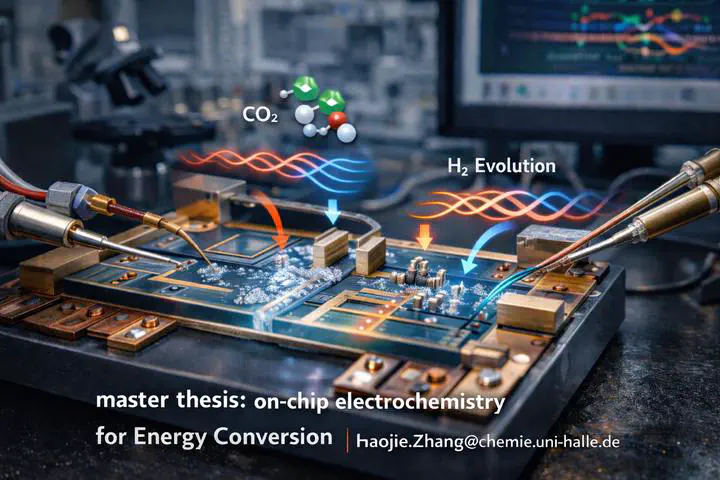 Image credit: GMC
Background
On-chip electrochemistry integrates microfabrication, microfluidics, and electrochemical techniques to enable highly controlled, high-throughput, and spatially resolved investigation of electrochemical reactions. Such platforms are particularly powerful for studying energy-relevant reactions, including CO₂ reduction (CO₂RR), hydrogen evolution (HER), and oxygen evolution (OER), under well-defined transport, electric-field, and interfacial conditions.
By miniaturizing electrochemical systems onto chips, it becomes possible to precisely control mass transport, electric fields, reaction environments, and electrode architectures, thereby providing new insights into reaction kinetics, selectivity, and stability that are difficult to access in conventional bulk electrochemical cells.
Possible focus areas
Design and fabrication of micro-/on-chip electrochemical devices (e.g. microelectrodes, lab-on-a-chip systems)
Integration of electrodes with microfluidic platforms for controlled electrochemical testing
On-chip electrochemical characterization of CO₂RR, HER, or OER
Coupling on-chip electrochemistry with in-situ or operando techniques (e.g. optical microscopy, Raman spectroscopy, AFM-based methods)
Data analysis and interpretation of reaction kinetics and selectivity on the microscale
Your profile
- Bachelor’s degree in chemistry, Physics, Materials Science, Chemical Engineering, or a related field.
- Strong interest in catalysis, electrochemistry, or spintronics.
- Basic laboratory or simulation experience (e.g., electrochemical techniques, nanomaterial synthesis, or quantum chemistry).
- Motivation to work in an interdisciplinary environment bridging chemistry, physics, and materials science.
- Good communication skills in English (both written and spoken).
We offer
- A highly interdisciplinary research environment within an international team.
- Access to state-of-the-art facilities for electrochemical testing and materials characterization.
- Opportunity to contribute to cutting-edge research in spin-dependent catalysis.
- Close supervision and the possibility to publish results in peer-reviewed journals.
Application
Please submit the following documents as a single PDF:
- Motivation letter
- Curriculum Vitae (CV)
Send your application to: haojie.zhang@chemie.uni-halle.de