Master's Thesis Topic Available – Chiral Induced Spin Selectivity (CISS) Catalysts
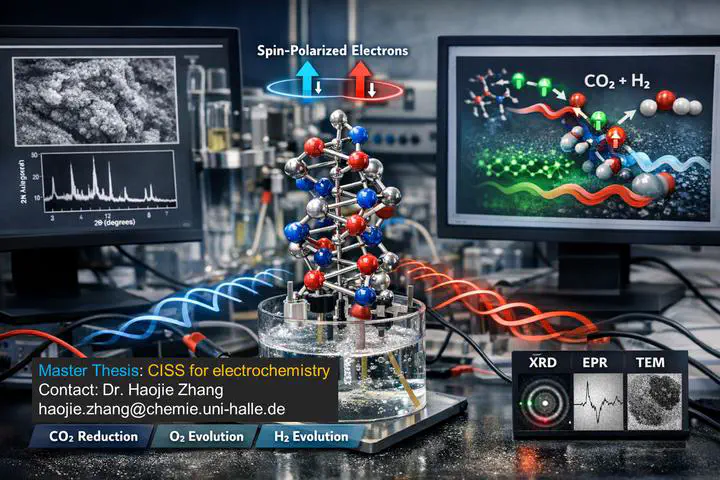 Image credit: GMC
Background
The Chiral Induced Spin Selectivity (CISS) effect has emerged as a fascinating quantum phenomenon that couple’s electron spin with molecular chirality, leading to spin-polarized electron transport without external magnetic fields. This effect opens new possibilities for designing highly selective and energy-efficient electrocatalysts for key reactions such as CO₂ reduction (CO₂RR), oxygen evolution (OER), and hydrogen evolution (HER).
Understanding and harnessing CISS in catalytic materials can fundamentally transform electrocatalysis by improving reaction kinetics, selectivity, and stability through spin-controlled charge transfer.
Possible focus areas
Synthesis of chiral inorganic or hybrid catalysts (e.g., chiral metal oxides, chiral coordination complexes, or nanostructured catalysts).
Surface modification of electrodes with chiral molecules or ligands.
Electrochemical testing for CO₂RR, OER, or HER activity and selectivity.
Characterization of catalysts with McAFM, XRD, EPR, SEM, TEM …
Correlation of spin polarization with catalytic performance.
(Optional) First-principles or DFT-based simulation of spin-dependent charge transfer processes.
Your profile
Bachelor’s degree in chemistry, Physics, Materials Science, Chemical Engineering, or a related field.
Strong interest in catalysis, electrochemistry, or spintronics.
Basic laboratory or simulation experience (e.g., electrochemical techniques, nanomaterial synthesis, or quantum chemistry).
Motivation to work in an interdisciplinary environment bridging chemistry, physics, and materials science.
Good communication skills in English (both written and spoken).
We offer
- A highly interdisciplinary research environment within an international team.
- Access to state-of-the-art facilities for electrochemical testing and materials characterization.
- Opportunity to contribute to cutting-edge research in spin-dependent catalysis.
- Close supervision and the possibility to publish results in peer-reviewed journals.
Application
Please submit the following documents as a single PDF:
- Motivation letter
- Curriculum Vitae (CV)
Send your application to: haojie.zhang@chemie.uni-halle.de